What is VAT?
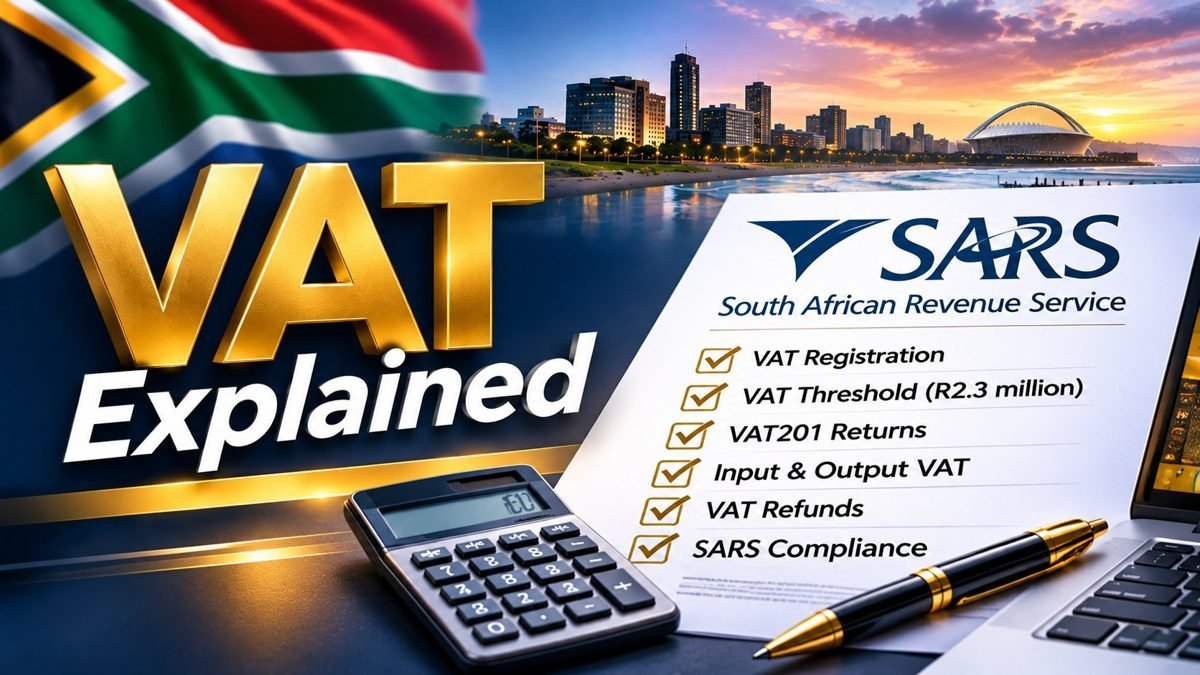
VAT is an indirect tax: the business collects it from customers on behalf of SARS. A registered business (a “vendor”) adds VAT to the price of taxable goods and services — this is output VAT. It can usually deduct the VAT it paid on business purchases — input VAT — provided it holds valid tax invoices. The difference is paid to (or refunded by) SARS.
Who has to register?
- Compulsory registration: when taxable supplies exceed, or are likely to exceed, R2.3 million in a consecutive 12-month period (the threshold was R1 million before 1 April 2026).
- Voluntary registration: possible once taxable supplies exceed R120,000 in a 12-month period, subject to SARS requirements.
- Some supplies are zero-rated (taxed at 0%) and some are exempt — the treatment affects both registration and what you can claim.
How does it work in practice?
Each VAT period, the vendor totals output VAT on sales and input VAT on purchases, and submits a VAT201 return to SARS. Most small and medium businesses file every two months; vendors with taxable supplies above R30 million file monthly. Manual returns are due by the 25th of the month after the period ends, and eFiling returns and payments by the last business day of that month.
A simple example
A registered business sells services for R100,000 plus R15,000 VAT. In the same period it buys supplies for R40,000 plus R6,000 VAT, with valid tax invoices. It pays SARS R15,000 − R6,000 = R9,000.
Records that matter
- Tax invoices issued and received
- Credit and debit notes
- Bank statements and payment records
- VAT201 returns and SARS correspondence
- Records must generally be kept for five years from the date the return was submitted.
Common mistakes
- Claiming input VAT without a valid tax invoice
- Registering late after crossing the threshold
- Charging VAT before registration is approved
- Books not reconciled, so returns are estimates
- Missing the VAT201 due date
When should you get professional help?
If you are close to the threshold, unsure whether your supplies are standard-rated, zero-rated or exempt, behind on VAT returns, or have received a SARS VAT query, get help early.